

If there’s one lesson that’s carried me through nineteen years in product, it’s this: get comfortable with the idea of getting uncomfortable. Every real growth spurt in my career has come from a moment where I had to set aside what I knew and start again. That discomfort is where I’ve found strengths I didn’t know I had.
Starting From Zero
I began at Samsung R&D, where I eventually became Chief Designer and helped scale the design practice to 80 people. It was structured, well-resourced, and I knew exactly how to operate within it.
It was the country’s first R&D center of its kind, and I joined as a Senior UX Designer working on open briefs across domains. Design, at its core, is about solving complex problems, and the scope there was enormous: healthcare solutions, smart energy, native mobile apps. The briefs were often just a single line. What should Samsung do in smart energy this year? What should a foldable smartphone with two screens be, for a real user? That second question revealed itself a year later as the Samsung Galaxy Fold. Answering a brief like that meant deep research, competitor study, and looking at a product through a 360-degree lens, then shaping an experience that made the technology feel like a natural part of someone’s life rather than a gadget bolted onto it.
Then I chose to walk away from that and join a startup that had never had a designer at all. As Head of Design at what was then a scrappy, angel-funded company called FirsTouch (later Indus OS), one of my first tasks was to give what might be the simplest talk of my career: an introduction to what design even is.
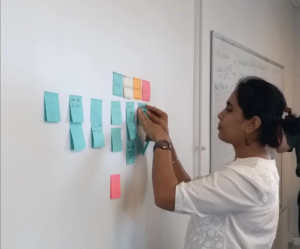
That transition demanded real humility. I had to set aside the scale and polish I was used to and speak the language of business and technology first, while still holding onto the confidence of knowing my craft. What actually worked was opening up the design practice to everyone in the company, and genuinely believing that innovation could come from anywhere, not just from a design team. It was humbling, and it was also the right call.
Building the “First Touch”
Our mission at FirsTouch was audacious: to become the mobile experience of choice for the next 500 million Indians who would put their hands on a smartphone for the very first time. We had months, not years, to make that real.
Working with a single designer, I helped build an entire design language from the ground up, one built on two words we kept coming back to: Simplicity and Celebration.
It had to feel intuitive to someone touching a touchscreen for the first time, and it had to feel like something worth celebrating, not just tolerating. That ethos became the foundation the company continued to build on for years after I moved on.
One of the harder challenges wasn’t design at all; it was translation. Stakeholders and investors needed a simple answer to “what does this product actually do?” I brought in external vendors to help orchestrate an explainer video that made our promise legible to anyone, regardless of background. It taught me that my job was never really about design deliverables. It was about sitting at the intersection of technology, business, and human interaction, and the form that took became secondary to that.
The quieter, harder part of that journey was proving the platform wasn’t just elegant; it was defensible. I led the work to file three patents that captured the core innovations behind the product, and that credibility is what eventually catalyzed its adoption into the Samsung Galaxy marketplace, reaching hundreds of millions of users. The angel investor who backed the company in those early days later reflected that the design principles we set in those first few months still guide it today.

Innovation as a Shadow Discipline
That early lesson- that innovative ideas can come from anywhere- is one I still practice today, now leading innovation at a fintech focused on financial inclusion for migrant workers. Getting comfortable with discomfort again meant stepping into an entirely new context: a different industry, a different user, a different set of constraints.
Establishing an innovation practice inside a fast-growing, multidisciplinary organization meant doing the same thing I did at my first startup: simplifying what innovation actually means, and deliberately refusing to limit it to a certain set of people or titles. I think of innovation as something of a shadow discipline. It rarely announces itself, and it rarely comes from where you expect. The job is to stay patient, persistent, and curious enough to notice it when it shows up, and to build a culture where anyone feels safe enough to bring it forward. That’s also what leadership means to me in practice: being comfortable putting other people in front to take the credit.
What I Carry Forward
The population I design for has changed completely, from first-time smartphone users in India to blue-collar migrant workers navigating financial systems that weren’t built with them in mind. The UAE alone hosts close to 9 million migrant workers, the bulk of its private-sector workforce, and in Abu Dhabi, official government data puts blue-collar workers at 54 percent of the employed population. Zoom out, and the number gets much bigger: the World Bank estimates that 1.3 billion adults worldwide are still outside the formal financial system. That’s the “next billion” I keep coming back to, not a hypothetical, but a population that’s already here, working, earning, and still underserved by the products meant to serve them.
But the underlying belief hasn’t changed: exclusion is rarely about access to a product. It’s about trust, context, and whether anyone bothered to design with you in mind rather than around you. Building that trust through digital products, and figuring out where AI genuinely helps deliver a better product strategy for this segment versus where it just adds noise, is the challenge I’m most excited about right now.
One thing has stayed constant across every organization I’ve walked into and out of: the relationships. An organization, at the end of the day, is just a group of humans who happen to overlap for a while. Each of them carries a wealth of experience shaped by a completely different context than mine, and I’ve come to treat that as a source of learning rather than a footnote. A coffee or a lunch is often my way of getting to know someone at a deeper level; some of those people became mentors, some rooted for me as I moved on to somewhere else entirely, and some are still my sounding board today. Investing in relationships at work isn’t a networking habit for me. It’s what helps me grow as a human and stay inspired.
It reminds me of how trees survive in a forest. Their root systems connect underground through vast fungal networks, sharing nutrients and signals across distances, even between different species. A tree rarely grows in true isolation. Neither do we.
So if there’s one thing I’d ask you to sit with after reading this: think about the relationships you’re building right now, in whatever organization you happen to be in. Who are you really getting to know? And who might you become, because you took the time to find out?
Sources: UAE migrant worker figure from the International Labour Organization (ilo.org); Abu Dhabi blue-collar workforce figure from the Statistics Centre – Abu Dhabi (SCAD), via Gulf News; global unbanked adults figure from the World Bank’s Global Findex Database 2025 (worldbank.org).