
Across the Middle East, the ambition is clear. National agendas such as Saudi Vision 2030 and the UAE’s national innovation strategy have put innovation at the top of boardroom agendas. Companies have responded with workshops, pilots, accelerators and training in methods like Design Thinking and Lean Startup. Yet these initiatives rarely add up to a repeatable ability to turn ideas into value.
The gap isn’t unique to the region. In Boston Consulting Group’s 2024 Most Innovative Companies report, 83% of executives ranked innovation among their top three priorities. Only about 3% of companies were considered truly “innovation ready.”
From working with large organizations across industries, I see the same five traps repeatedly.
Five traps
Trap 1: Fragmented ownership. HR runs training, an innovation team runs pilots and accelerators, and strategy runs transformation programs. Each effort may be valuable, but without coordination they run in parallel instead of reinforcing one another.
Trap 2: Too many tools, no shared framework. Design Thinking, Lean Startup, Jobs-to-Be-Done, agile experimentation and corporate venturing are all useful. The trouble starts when teams speak different innovation languages. Collaboration gets harder and results become inconsistent.
Trap 3: Innovation as a temporary initiative. The cycle is familiar: enthusiasm, a wave of pilots, a leadership change, then lost momentum. In my experience, building real capability takes three to five years of sustained effort, which is longer than most programs survive.
Trap 4: Training without application. Employees attend workshops and learn new tools, then go back to their day jobs with no real problem to use them on. Without practice, the knowledge fades within months.
Trap 5: Isolated experiments. Large companies launch many pilots and idea campaigns but scale very few. Scaling needs governance, funding, an operational owner in the business unit and senior sponsorship. Without these, pilots stay experiments. As an innovation ISO expert put it at a recent panel I moderated, asking employees for ideas that never become real solutions is a form of disrespect. People notice when their ideas disappear, and the next call for ideas is met with silence.
What works: innovation as a management system
The organizations that break this pattern treat innovation as a management system that spans every level of the company, not as a collection of projects. The Global Innovation Management Institute’s (GIMI) High Performance Innovation framework organizes that system into four elements: Strategy, Capacity, Discipline and Performance (GIMI, 2025).
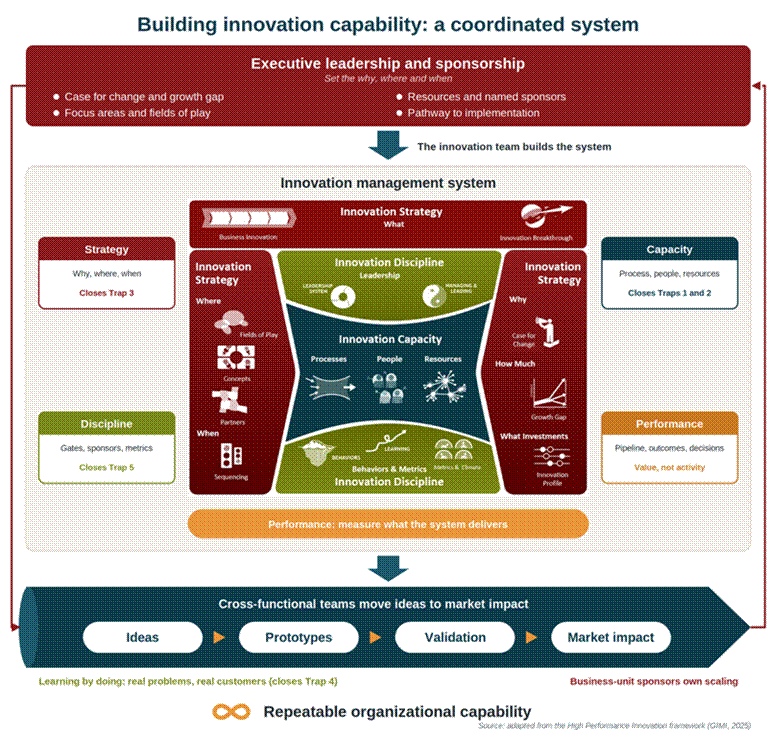
Building innovation capability as a coordinated system. Adapted from the High Performance Innovation framework (GIMI, 2025).
1. Strategy: executives define the why, where and when. Leadership’s first job is to set out three things: the growth gap the company needs to close, the opportunities it wants to pursue, and the focus areas where innovation should create value. When innovation is tied to the growth strategy, it survives leadership changes (Trap 3).
2. Capacity: one process, the right people, real resources. The innovation team’s role shifts from running events to building the system. That means a common innovation process every function understands, the people and partners to carry it out, and dedicated resources. A shared framework doesn’t mean dropping favorite tools. Design Thinking and Lean Startup become techniques used at specific stages of one process (Trap 2). A single owner coordinates the HR, strategy and innovation efforts (Trap 1). The same owner should govern AI: which tools teams use, shared prompt libraries and clear rules. Otherwise every department buys its own tools and writes its own standards.
3. Discipline: governance, metrics and behaviors. Clear decision gates, funding matched to each stage and named business-unit sponsors give promising projects a path beyond the pilot. Who sits at the gate matters as much as the gate itself. If the panel comes entirely from the unit that will own the result, you have not built a selection process. You have built a defence of the current portfolio. Sponsors support the teams, open access to resources and make sure validated prototypes have a home for implementation (Trap 5).
Every gate makes two kinds of mistake: funding what should have been stopped, and stopping what should have been funded. Only the first ever becomes visible.
4. Performance: measure what the system delivers. Activity metrics, such as ideas submitted or workshops held, say little. Track pipeline health: how many projects sit at each stage and how quickly they move. Track it alongside outcomes like revenue from new offerings and the skills being built in people. Timing matters too. Ask a breakthrough project for its ROI in month 3 and the team will give you a number, but they will have made it up. Early on, track which critical assumptions have been tested and retired (McGrath and MacMillan, 1995). Finally, measure your own decisions. Record who decided what, and what happened 18 months later. What gets measured gets funded.
Learning by doing
Within this structure, the engine is cross-functional teams working on real business opportunities. They use the common process to move projects from idea to prototype to validation. This is action learning: people build skills by applying them to problems that matter, which directly answers Trap 4.
A practical starting point
For leaders who want to move from initiatives to capability, three questions make a useful diagnostic:
- Can every team describe the same innovation process in the same words?
- Does every innovation project have a business-unit sponsor who will own it if it succeeds?
- Do you measure the value your pipeline creates, or only the activity it generates?
If the answer to any of these is no, more workshops won’t close the gap. Building the system will.
When these four elements align, ideas move from exploration to market impact, employees see their contributions become real, and innovation becomes something the organization simply knows how to do.
Sources
Boston Consulting Group. (2024). Innovation systems need a reboot. BCG.
Global Innovation Management Institute. (2025). High Performance Innovation Management, Level 3. GIMI.
McGrath, R. G., and MacMillan, I. C. (1995). Discovery-driven planning. Harvard Business Review, 73(4), 44 to 54.