
Let me start with a number that should bother you more than it does.
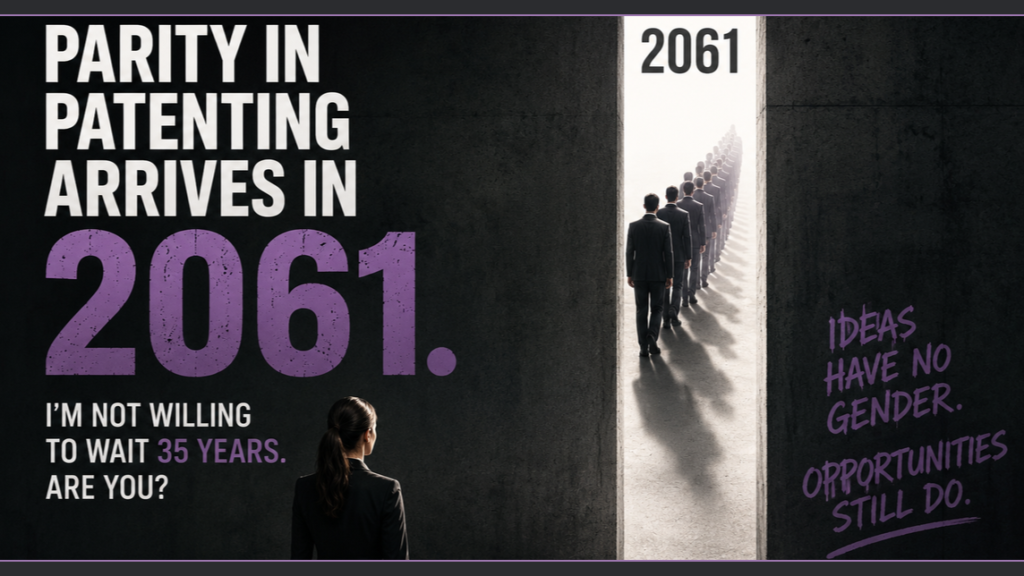
According to WIPO, at the current pace, the share of women inventors listed on international patent applications will not reach parity until 2061. That’s 35 years away. And it’s the optimistic global figure, in Europe the projection is 2088.
Sit with that. A girl born this year will be near retirement before the patent system is as likely to record her invention as her brother’s. We are not talking about a gap that’s stuck; we’re talking about one that is closing just so slowly that an entire working lifetime will pass before it closes at all.
For two decades: 1999 to 2020 — women were involved in just 23% of international patent applications, while men were involved in 96%. Women make up only about 13% of inventors listed, and by some measures fewer than 10% of patents globally are attributable to women. This is the engine room of the modern economy, the place where ideas become protected, fundable, own-able assets and half the population is barely in the room.
Now, the part where I lose some of you: I don’t want you to care about this because it’s unfair.
I want you to care because it’s expensive.
This is the argument I keep returning to from a Think Tank session with Asmi Chakraborty, PhD , Director at the Massachusetts Life Science Center. She described, in plain operational terms, how an innovation system corrects itself: deliberately funding historically overlooked fields like women’s health, building socio-economically diverse patient biobanks, and blinding grant applications so reviewers judge the science, not the name. She did not make a moral case, she was just fixing a market that was leaving value on the table.
Because the market failure is enormous. Women make 80–90% of consumer purchasing decisions. Yet most products, services, and especially health innovations are still designed without meaningful female leadership and the results show up in the data. Femtech, addressing the health of 51% of humanity, is a market valued in the hundreds of billions, with one analysis putting the underserved opportunity at $360 billion. And how much venture capital does it attract? Less than 2%. In 2024, the entire femtech sector raised just 8.5% of digital-health funding, down from its 2020 peak. An estimated one billion women are now postmenopausal, and menopause research remains a rounding error.
This is not charity waiting to happen. It is the largest underserved market on earth, hiding behind the word “niche.”
Here’s why the slow pace isn’t an accident.
It would be comforting to call this a pipeline problem, not enough women in STEM, give it time. But the research says otherwise. Studies of patent examination find that more than half of the gender gap in whether a patent is ultimately granted is driven by bias, not by differences in the inventions themselves. And most of the recent gains in women’s patenting come from mixed-gender teams, while all-women inventor teams remain vanishingly rare. So when we systematically keep women out, we don’t just commit an injustice, we lose output, because mixed-gender teams are shown to produce the most novel and disruptive inventions of all.
Read that again: the exclusion is making our innovation worse, not just less fair.
This is why I stopped waiting.
Throughout the years, being present in innovation rooms across corporates, governments, and innovation ecosystems on six continents, I was unfortunately, for far too long, the only woman or one of very few at the table. The striking part is that many of the women in innovation I met afterward shared the very same experience. You can see this as a personal anecdote, or you can recognize it as a system producing exactly the numbers above, one room at a time. I chose the latter. That’s why I founded Voice of Women in Innovation: not to wait until 2061, but to compress the timeline. To make women in innovation visible. To direct opportunities toward them. To make it easy to find the woman speaker, the woman founder, the woman Chief Innovation Officer who was always there, but too often overlooked.
And I’m not the only one who stopped waiting. In a conversation about patents, Joelle Flynn put the same math in even blunter terms: only about 4% of patents issued to single inventors over the past decade have gone to women, and women-owned or women-led companies receive just 1.9% of venture capital. She reads those numbers not as grievances but as lost innovation, unrealized potential, and unequal access to opportunity. She built FIRE, a platform designed to increase the number of patents and companies coming from women, equipping them to create, protect, launch, and scale their innovations.
A fair challenge: the trend is improving, isn’t this fixing itself? Slowly, yes. But “slowly improving” and “on track” are not the same sentence. The honest reading of the data is that the gains are real, fragile, concentrated in mixed teams, and still shadowed by a bias that accounts for over half the remaining gap. 2061 is not a forecast we are powerless against. It is the result of every leader who looks at these numbers and decides they’re someone else’s problem.
So here is what I’d ask of the people who actually run innovation, the ones choosing who gets funded, cited, promoted, and put on stage:
- Blind your processes where you can, the way the best grant programs already do.
- Fund the overlooked markets, because they’re not small, they’re the future customer.
- Sponsor women, don’t just mentor them; mentorship gives advice, sponsorship gives the room.
- Measure who is actually in the room when the consequential decisions get made, because what you don’t measure, you will quietly let slide to 2061.
I’m not willing to wait 35 years.
Are you?
Sources
- Patent parity by 2061 (Europe ~2088); women involved in 23% of international applications 1999–2020 vs. 96% for men; ~13% of listed inventors: WIPO, The Global Gender Gap in Innovation and Creativity (2023). https://www.wipo.int/web/economics/w/blogs/gender-parity-patenting | https://www.weforum.org/stories/2024/03/women-inventors-gender-gap-stem-patents/
- Fewer than ~10% of patents globally attributable to women: WIPO Economics / Women and IP Symposium 2025. https://www.wipo.int/en/web/economics/w/blogs/unlocking-women-s-stem-potential-for-inclusive-innovation
- Over half of the gender gap in patent grant outcomes attributable to bias: “To Grant or Not to Grant: Inventor Gender and Patent Examination Outcomes,” American Economic Association. https://www.aeaweb.org/conference/2025/program/paper/8ENnyBnB
- Mixed-gender teams produce the most novel and disruptive inventions: “Gender disparity in U.S. patenting,” Humanities and Social Sciences Communications (Nature), 2025. https://www.nature.com/articles/s41599-025-06038-6
- Femtech: a ~$360B underserved market; ~8.5% of digital-health funding in 2024: Galen Growth, Femtech’s Rise and Roadblocks (2025). https://www.galengrowth.com/femtechs-rise-and-roadblocks-digital-health-funding-growth-and-gaps/
- Femtech receives <2% of total VC; market projected to ~$97B by 2030; ~1 billion women postmenopausal: Ignitec / Venquis (2025–26). https://www.ignitec.com/insights/femtech-the-underestimated-healthcare-revolution-for-women/
- Women’s health reframed as an investable market; women make 80–90% of consumer/health decisions: World Economic Forum & BCG, Women’s Health Investment Outlook (Jan 2026). https://www.weforum.org/stories/2026/01/women-health-investment-outlook-mapping-opportunity-mobilizing-investment/
- Equity-funding gap (illustrative): in 2024, all-female founder teams received ~2% of UK equity investment vs. ~81% for all-male teams. Keltie, Where are the Women? The Innovation Gender Gap (2025). https://www.keltie.com/knowledge/where-are-the-women-the-innovation-gender-gap
- Think Tank session: Asmi Chakraborty, Massachusetts Life Science Center. GIMI Think Tank Speaker Series.