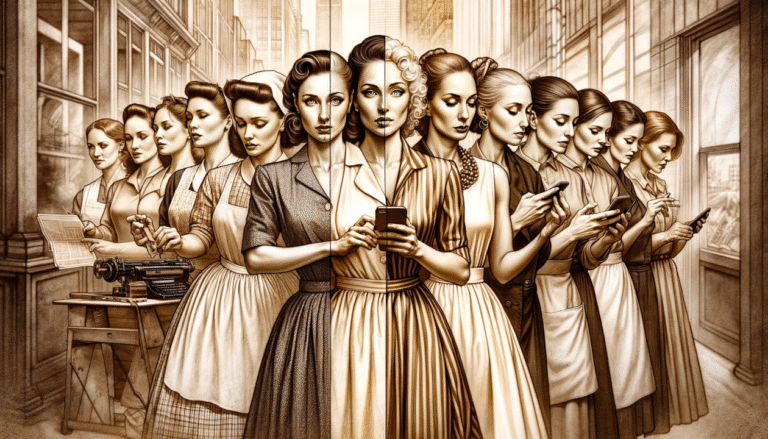

From consumption to leadership: Women as agents of innovation in fashion
Authors: Carlota Castro Fariña [ Marketing Manager VESS- venture studio]
The fashion industry stands as one of the most influential economic and cultural sectors worldwide. Its ability to generate trends, engage in dialogue with society, and anticipate social transformations has made it a mirror of the times. Today, however, fashion is undergoing a profound redefinition: the challenges associated with sustainability, digitalization, and the emergence of new consumption models demand a rethinking of traditional dynamics.
In this context, innovation emerges not only as a driver of competitiveness but as an essential condition to ensure the sector’s relevance and resilience. Innovation is no longer an option; it is a strategic necessity that encompasses everything from design and production to communication and customer experience.
Yet innovation does not occur in a vacuum: it is shaped by vision, leadership, and values. In this regard, the role of women is particularly significant. Historically associated with consumption and image, women today stand as creators, leaders, and agents of change, offering an indispensable perspective to transform fashion into an industry that is more inclusive, sustainable, and aligned with contemporary challenges.
The current context of fashion
The fashion sector is immersed in an unprecedented process of transformation. Traditionally characterized by fast production cycles and an intensive consumption model, it now faces pressures stemming from globalization, digitalization, and a growing social and environmental awareness.
Sustainability has shifted from being an emerging trend to becoming an imperative. Regulatory pressure, together with the demands of increasingly informed consumers, compels brands to rethink their value chains, invest in responsible materials, and implement traceability processes that guarantee ethical practices.
At the same time, digitalization has emerged as a transversal axis that is redefining not only brand communication but also the way fashion is designed, produced, and distributed. Virtual fashion, artificial intelligence applied to personalization, and the integration of the metaverse are shaping a new paradigm in which the boundaries between the physical and digital worlds are increasingly blurred.
Added to this is the rise of alternative consumption models such as circular economy practices, clothing rental, and resale, all of which challenge the industry’s traditional logic and reinforce the need to innovate across every stage of the process.
Within this framework, innovation stands as the backbone of competitiveness and business survival. However, the way in which these innovations are conceived and applied is profoundly shaped by the diversity of voices and leaderships that participate in the sector. It is here that the presence of women acquires singular relevance.
Women in fashion: History and present
The relationship between women and fashion has been, throughout history, complex and multifaceted. For centuries, women were conceived primarily as muses or consumers, occupying a passive role within an industry largely dominated by male perspectives. The great designers who established the canons of elegance and sophistication in the nineteenth and twentieth centuries reinforced a narrative in which women appeared more as objects of inspiration than as creative subjects.
However, this narrative has progressively evolved. Pioneering figures such as Coco Chanel, Elsa Schiaparelli, and Madeleine Vionnet broke with established logics and demonstrated that women could lead with their own voice, not only in aesthetic terms but also at the business and strategic levels. Their legacy opened the door to new generations of female creators and executives who today shape a diverse and plural landscape within the sector.
At present, women occupy a central role in the fashion industry across multiple dimensions: from design and creative direction to the management of major conglomerates, as well as technological research, communication, and the building of digital communities. The rise of entrepreneurs and founders of fashion-tech startups, many of them focused on sustainability, traceability, or digitalization, provides clear evidence of the impact that female leadership is having on new business models.
This transition, from women as recipients of trends to women as architects of innovation, reflects not only the conquest of professional spaces but also a profound cultural shift: fashion is no longer understood solely as a vehicle for aesthetic expression but as a space of economic, social, and environmental transformation driven, to a great extent, by female voices.
The numbers speak for themselves
IIt is a fact that fashion remains one of the most feminized sectors in terms of employment; it is estimated that over 70% of the global fashion workforce (Zipdo, 2025) is made up of women. This stands in stark contrast to the significant lack of female representation at the highest levels of leadership, highlighting a troubling structural contradiction. In terms of strategic positions, fewer than 14% (Fashion Revolution, 2020) of major brands are led by a woman, a figure that reflects the persistence of what has been called the “Glass Runway.” Globally, only 10.4% (Women Business Collaborative, 2024) of CEOs in Fortune 500 companies are women, while on average women occupy just 8% (World Economic Forum, 2025) of the most senior executive roles worldwide.
The contrast becomes even clearer when looking at leadership positions in Europe and the United Kingdom. In the UK, 39% of executive roles and 24% of so-called “Power Roles” (such as CEO, CFO, or Creative Director) are held by women (British Fashion Council, 2024). Furthermore, only 9% of those positions are occupied by people of color (British Fashion Council, 2024), adding a racial dimension to the inequality.
On the other hand, the sector also presents a genuine opportunity for impact: organizations with more women in senior leadership tend to achieve stronger financial performance and greater capacity for innovation. In broader corporate sectors, reaching 30% female representation at the executive level has been associated with an increase of around 15% in net profitability. And while figures this precise are not always available for fashion, studies consistently show that diversity strengthens decision-making and enhances business sustainability. In fact, companies with higher levels of diversity are 39% more likely to achieve above-average financial performance (McKinsey & Company, 2023).
A particularly relevant and encouraging example comes from Denmark: in the latest edition of Copenhagen Fashion Week, 26 of the 42 brands were founded and led by women (The Guardian, 2025). Finally, it is worth considering the global scale of the sector: approximately 430 million people work in the fashion, clothing and textile production industry — representing nearly 12.6% of the world’s labour force (Solidarity Center, 2023) — underscoring the magnitude of the transformation that could be achieved if greater equity in leadership positions were realised.
Innovation through female lenses
Innovation in fashion is not limited to the application of new technologies or the redesign of industrial processes; it is, above all, a matter of vision and purpose. In this sense, female leadership is contributing a distinctive perspective that responds to the urgency of transforming the industry into one that is more conscious, diverse, and resilient. The way women approach innovation is often accompanied by a particular sensitivity to social and environmental impact, questioning not only what is produced, but also how it is produced and for what purpose.
Recent examples confirm this. British designer Stella McCartney, a pioneer in sustainability, has demonstrated that luxury and textile innovation can coexist with a firm environmental commitment, driving the adoption of alternative materials that today inspire the entire industry. In a different register, Miuccia Prada has successfully reinterpreted the codes of tradition and cultural heritage through an intellectual lens, positioning her brand as a benchmark of experimentation and conceptual avant-garde. Beyond established fashion houses, new forms of leadership are emerging that embody the disruption of the present. Spanish entrepreneur Araceli Gallego, founder of the platform SLOW Fashion Next, has helped to weave an ecosystem of knowledge and entrepreneurship around sustainable fashion, connecting innovation, education, and community. Across the Atlantic, Colombian co-founder Lina Bustillo has built Vestido Verde, a digital platform that combines education, traceability, and circular economy practices, generating impact across Latin America.
What distinguishes many of these projects is not solely their technical innovation, but the integration of social sensitivity as a driver of change. In contrast to business models focused exclusively on profitability, female leaders are advancing initiatives that create shared value. Fashion thus becomes a vehicle to make diverse bodies visible, to promote gender equality, or to give voice to communities that have historically been overlooked. Designers who incorporate inclusive sizing, startups developing accessible digital experiences, and brands that open their processes to citizen participation all demonstrate that innovation can be both profitable and socially transformative.
This type of leadership transcends the immediate logic of solving operational problems. What defines innovation through a female lens is its ability to project possible futures. By placing empathy, diversity, and commitment at the center of strategy, women are shaping a model of industry that functions as a laboratory for social and environmental change. It is not merely about designing collections or launching technological platforms, but about imagining new forms of relationship between fashion, the planet, and society. In this regard, the role of women in fashion innovation is neither accessory nor complementary: it is a necessary condition for the industry to reinvent itself in a genuine and sustainable way.
Pending challenges
Despite the progress made, the role of women in innovation within the fashion sector still faces structural obstacles that limit its full development. While the industry has increasingly brought visibility to female creators, designers, and entrepreneurs, women remain underrepresented in senior management positions, in technological fields, and in strategic decision-making. Fashion, as a global sector, reflects the same gender gaps that pervade other economic and business domains: greater difficulty in accessing financing, lower recognition in environments dominated by traditional logics, and a persistent undervaluation of female leadership compared to more established male models.
Added to this is the persistence of stereotypes that continue to link women primarily to the aesthetic or emotional sphere, undermining the legitimacy of their role as innovators in highly technical areas such as material development, artificial intelligence applied to fashion, or the implementation of digital traceability systems. These biases not only affect the visibility of women but also restrict the diversity of approaches the industry needs in order to confront its most pressing challenges.
The lack of female role models in specific segments of fashion technology and in the executive boards of major conglomerates perpetuates an incomplete narrative. Although initiatives in mentoring, training, and support networks are expanding, a significant gap still remains, one that conditions the growth and consolidation opportunities of many women entrepreneurs. Recognizing and addressing these challenges is essential to ensure that innovation is not a space reserved for a select few but rather an open process that effectively integrates the voices and visions of women in all their diversity.
Where we are headed: The future of the sector
The future of fashion stands at a turning point where innovation and gender equality cannot be understood as independent processes but as complementary forces. The transformation of the sector demands a comprehensive approach that combines technological development with an ethical and social perspective capable of redefining its very foundations. In this context, female leadership emerges as one of the keys to articulating real and sustainable change.
The growing inclusion of women in strategic decision-making spaces opens the possibility of building a more inclusive industry, one that not only responds to present challenges but also anticipates the scenarios of tomorrow. Innovation guided by diversity—of gender, thought, and culture—consolidates itself as an indispensable requirement to confront the challenges of sustainability, digitalization, and new models of consumption. Fashion, as a cultural reflection of society, has the capacity to become a catalyst for systemic transformation if these perspectives are placed at the heart of its strategy.
The coming years will be defined by the consolidation of technologies that will transform the ways in which fashion is produced, distributed, and consumed. Yet true disruption will not stem solely from technical advances, but from the ability of those who lead the sector to embed human values into these processes. Empathy, collaboration, inclusion, and social commitment must not be seen as add-ons, but as pillars that ensure the legitimacy and relevance of fashion in an increasingly conscious and demanding world.
In this sense, women are not an “addition” to the equation of innovation, but a fundamental condition for reconfiguring the industry toward a future in which creativity and responsibility coexist harmoniously. The fashion sector will only be able to sustain its relevance if it embraces the idea that female leadership is, in essence, leadership for the future.
Conclusion
Fashion, as both an industry and a cultural language, has always reflected the changes of its time. Today, amid a transformation shaped by sustainability, digitalization, and the search for new models of consumption, the role of women emerges with unquestionable relevance. Innovation in the sector can no longer be conceived without the voices and visions of women, who bring sensitivity, social perspective, and a commitment to a more just future.
Recognizing the importance of female leadership in fashion is not merely a matter of equity but a strategic condition for the development of the industry itself. Each time a woman leads a project, runs a company, launches a startup, or transforms a value chain, she is not only driving innovation but also rewriting the cultural and economic codes of fashion.
The collective challenge lies in making these trajectories visible, supporting them, and multiplying them, ensuring that the coming decades are marked by an ecosystem in which creativity, technology, and diversity are inseparably intertwined. Fashion has the opportunity, and the responsibility, to become a laboratory for social and environmental change. And it is in the hands of women, innovative and visionary, that this future finds its greatest possibility of realization.
References:
https://www.uniformmarket.com/statistics/global-apparel-industry-statistics?
https://www.britishfashioncouncil.co.uk/Innovation/Diversity-Equity-Inclusion–Belonging
https://www.forbes.com/sites/lisalindahl/2024/02/05/is-this-the-age-of-women-in-leadership/
https://www.nssgclub.com/en/lifestyle/39990/female-ceos-in-fashion-today-2025-numbers
Here is the event link of our upcoming event — you can register for it and join us on 20th September:
👉 Event Page:
https://www.linkedin.com/events/innovatingasbecoming-awoman-sjo7392865917694640129/theater/
👉 Register Here:
https://us02web.zoom.us/webinar/register/WN_eF5nGbDdSy2I7y-G4DB_0A#/registration